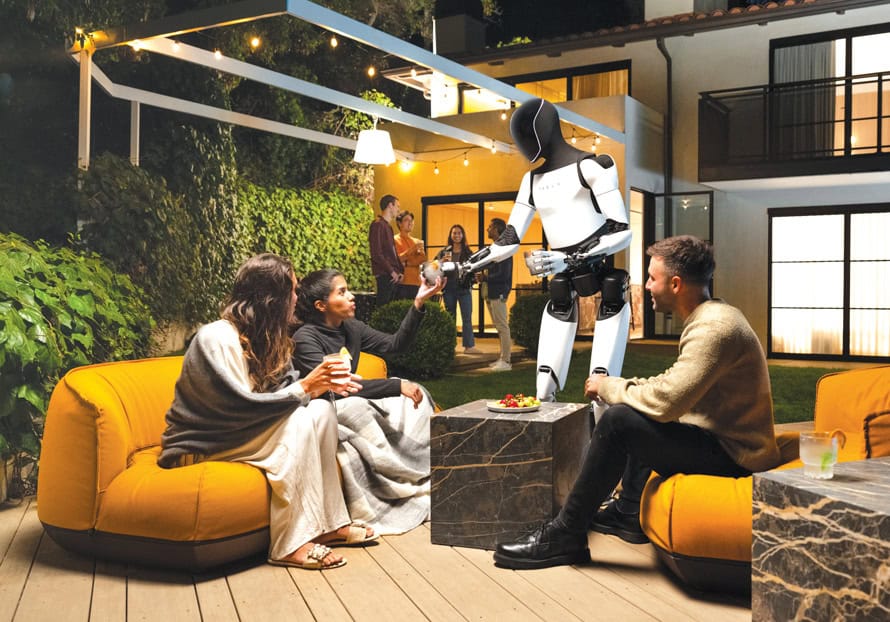
Ready or not, here they come. Helpful humanoids for the home are on the horizon and they’re promising to make life easier.
For decades, the “robot butler” has been more fiction than science… an unfulfilled dream for more efficient 21st century domestic life. Until now.
If the massive showroom floors of the Consumer Electronic Show 2026 are any indication, the wait for a mechanical helping hand is finally coming to an end. Here, more than a dozen companies demonstrated various robots, many of which could autonomously walk (or roll) around the home and happily perform a plethora of mundane chores.
For families, this potentially means newfound freedom—an escape from repetitive tasks. For while aging adults and those with mobility or dexterity challenges, there’s the possibility of using these devices to enjoy independence at home on an ongoing basis.
With some models available now and others coming soon, the following are a few of the mechanical work wizards worth considering.
Unitree G1
A general purpose agile bipedal ‘bot that can walk and run, climb stairs, dance and even perform martial arts, the Unitree G1 has an incredible 42 degrees of freedom, including a waist joint.
While its ability to do backflips and Tai Chi are fun to watch, the 4.3-foot-tall G1 is capable of more practical help. Its multi-fingered dexterous hands far ideal for precise handling of objects, advanced sensors like LiDAR and depth cameras (for environmental perception and navigation), and AI algorithms that help it to learn and adapt to your needs. GI can take over various tasks such as picking up objects, organizing and sorting items into different baskets, reducing manual cleaning time. It can wipe down surfaces and clean up spills and its also capable of folding laundry and putting clothes away as well as trash management, flipping food in a pan. It can also be trained to water plants, open curtains.
In Canada, Unitree’s G1 humanoid robots range from $30,000 to $100,000, depending on the specific model and features.
Tesla Optimus
Designed initially for factories, Telsa CEO Elon Musk believes he’ll be selling its Optimus-branded highly reliable humanoid robots for home use by the end of 2027. Humanoid robots will eventually outnumber humans, predicts Musk. “Who wouldn’t want a robot to, assuming it’s very safe, watch over your kids, take care of your pets, and if you have them, elderly parents,” Musk said. Optimus could learn tasks by watching videos, adds Musk.
Boston Dynamics’ Atlas
Revealed during Hyundai’s global CES media day presentation, the latest Atlas prototype robot is a humanoid robot from Boston Dynamics, one of the biggest names in robotics. (Hyundai Motor Group is Boston Dynamics’ majority shareholder.)
While primarily catering to the manufacturing sector, Boston Dynamics CEO Robert Playter says Atlas “marks the first step toward a long-term goal we have dreamed about since we were children—useful robots that can walk into our homes and help make our lives safer, more productive, and more fulfilling.”
Atlas is hands on with 56 degrees of freedom, fully rotational joints, a reach extending to 2.3 metres (7.5-feet), and the strength to lift up to 50 kg (110 pounds).
Boston Dynamics also announced a new partnership with Google DeepMind, to give its robots greater cognitive capabilities.
Realbotix
Unlike the other humanoid ‘bots in this round-up, Toronto’s Realbotix models, like “Aria” and “David,” have human-like skin, and are built more for companionship rather than manual labour.
In a move away from automated, these machines feature patented lifelike silicone skin. They each have up to 17 motors in their faces alone which give them the ability to replicate even the most nuanced of human expressions, like “skeptical” and “coy.”
At CES, the Robotix team focused mostly on AI where excited attendees witnessed an intriguing 2-hour demo that had the robots autonomously carrying on unscripted conversations with one another, thanks to their on-device AI which even lets them speak in multiple languages.
Robotix also showed off a third humanoid with a patented vision system capable of recognizing individuals and interpreting facial cues for emotional responses. He/she/it was also able to maintaining eye contact to minimize the “uncanny valley” that can break the suspension of disbelief.
Users can fully customize or interchange their robots face and body. The B-Series “best” model, to place on a table, starts at $20,000, while the M-Series full-body stationary robot starts at $95,000. The top-of-the-line F-Series offers full body movement, and additional features, and can range from $125,000 to $175,000. And, a word to the wise, a monthly subscription is also required for access to the full range of AI features and continual updates.
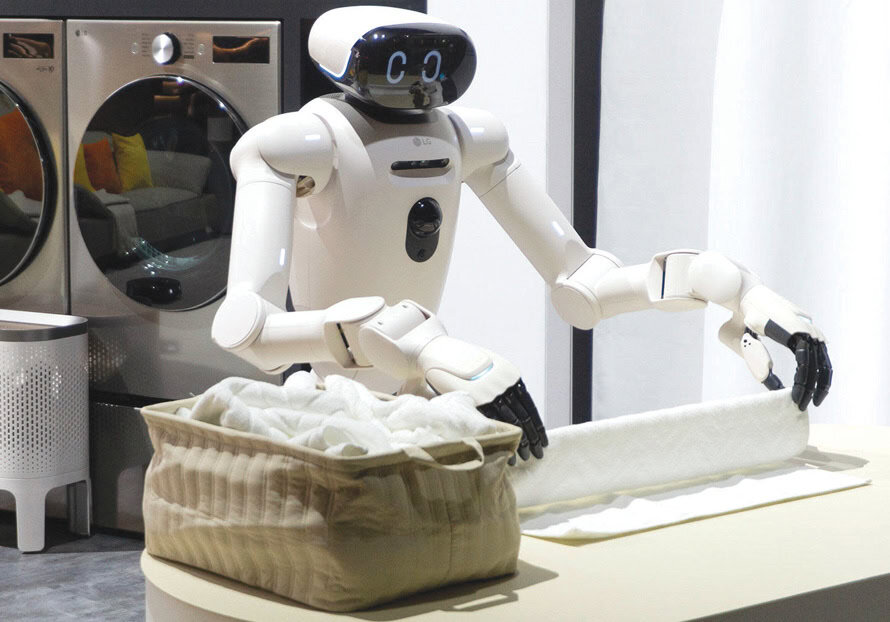
LG CLOiD Home Robot
A glimpse into a “zero-labour” future comes with CLOiD, a cute home robot designed to automate chores. Engineered with seven degrees of freedom, CLOiD features two articulated arms and ten individually actuated fingers that mimic human dexterity—allowing it to handle delicate tasks like folding laundry or loading the dishwasher.
Built on an AI platform that LG calls “Affectionate Intelligence,” the robot uses an array of sensors and an onboard AI chipset to navigate homes safely while providing a “give up chores” personalized experience.
While it can’t walk, and is a little slow at some of its assigned tasks, the live demos impressed the crowds.
Companion ‘bots, too
A CES Innovation Awards honouree, Mind With Heart Robotics’ “An’An” uses full-body tactile sensing to respond to human touch with lifelike behaviour. Handcrafted with Australian wool and sheepskin, the updated panda cub ‘bot features enhanced “emotional AI” that learns from voice and interaction habits over time (for a more personalized experience) and longer battery life (of up to 5 hours, thanks to its hybrid offline-online system).
The company has also debuted a new “Duncan Series Companion” paediatric robot to meet distinct emotional and therapeutic needs among children.
We also fell in love with Jennie from TomBot, which looks like a 10-week-old lab you never have to walk, feed, or clean up after!
Numerous clinical studies and randomized controlled trials have shown that interacting with robotic pets can reduce depression and loneliness, improved mood and an increase in positive affect (emotions like joy and cheerfulness), and a decrease in agitation and anxiety.
For the past 30 years, Marc Saltzman has been a recognized expert in consumer electronics, business tech, and automotive trends. Marc is a keynote speaker across North America and hosts the weekly Tech It Out podcast. You can follow Marc on X @ marc_saltzman.