When I stumbled off the night train from Transylvania at 5 am, distinctly the worse for wear, Tamas at the front desk of Budapest’s New York Palace Hotel didn’t blink. Within minutes, as if this were an everyday occurrence, which it may well be, he ushered me swiftly into my rather sumptuous suite reminiscent of La Belle Epoch. This was just the start of what came to be a disarmingly gracious Anantara curated hotel experience.

Showered and refreshed, I wandered down to find some breakfast in what’s known as The Deep Well. A sunken section of adjoining New York Café for hotel guests only, its head turning Baroque excesses were simply remarkable. Had I fallen through a gap in the space-time continuum? Chopin’s music drifted around marble gilded columns and chandeliers. Classically trained waiters carrying trays of delightful pastries swooped graciously by. Was I back in Budapest’s Golden Age. It wouldn’t have surprised me if I had been offered a traditional dog’s tongue (a long sheet of paper) along with pen and ink—tools furnished by the café back in the day for aspiring local artists and poets. My needs were more mundane. I settled for Smoked Salmon Eggs Benedict, under a mountain of hollandaise, topped with crispy string potatoes and a glass of Hungarian bubbly.
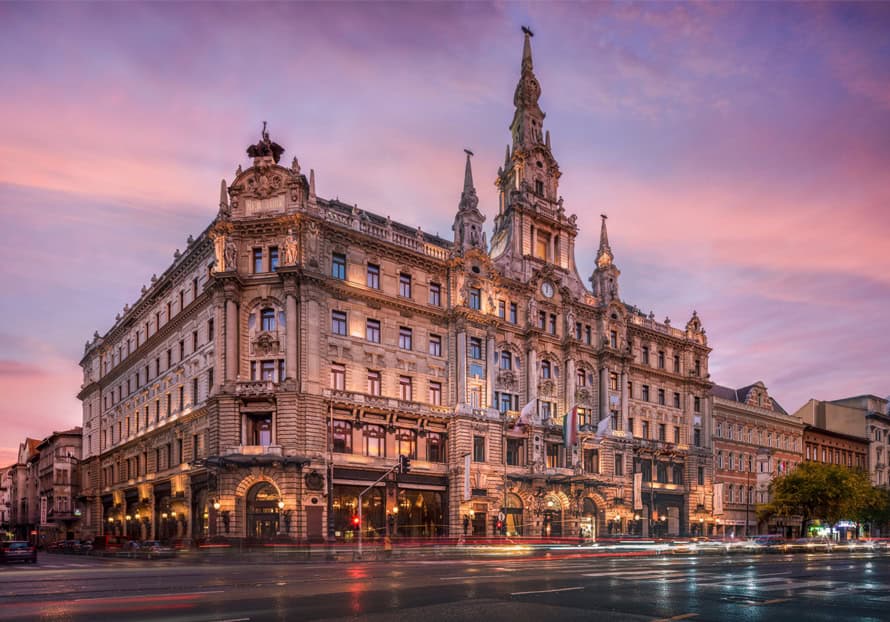
 The Anantara New York Palace occupies a space where Budapest’s history continues to whisper through the building’s marble columns, gilded ceilings, and mirrored walls —embedded in its very structure. Recent renovations stand faithful to what marvelling early travellers noted when they described the city as ‘The Paris of the East.’ This was a city that had an intoxicating belief that the future was its own.
Then as now, the exotic Baroque grandeur of the past is visible at every turn, on boulevards, in monuments, plazas and spas. Remnants of the literary and musical illuminati still overflow. Indeed, the vibrance that evaporated with the collapse of the Austro-Hungarian empire has returned.
Budapest is a city in which to amble and get lost. Cappuccino at a café, a boat tour of the Danube, lunch on a patio, magnificent museums, Ottoman baths, avenue after avenue of remarkable architecture. It deserves more than to be a brief bookend to a Danube cruise. But a short walk from the eclectic architectural style of the hotel, recognized as one of the best by star architect Alajos Hauszmann, is Andrássy Avenue. Linking the city centre with the rest of Budapest, the prestigious avenue of fine shops is also home to the Hungarian State Opera House. Built between 1875 and 1884 in the Renaissance Baroque style this is where Bartok and Kodaly are said to have performed.
After a day of roaming, I’m invited back to dine at the New York’s formal White Salon restaurant on the mezzanine. It overlooks the famous “best in the world” café. It’s here that I’m once again taken back to the time to when aspiring writers and artists would scribble out their works, ball them up, and pitch them across the floor to be reviewed by the salon members. If deemed worthy, the candidate would be invited to come forth, if not, the work would be scrunched up again and tossed back.
Nothing was being thrown back at my table that night! The zesty minerality of the toasty Kreinbacher bubbly was a fine start to a delicious meal. The star—traditional Chicken Paprikash with Hungarian Dumplings. The delicate smoky flavours of the sauce with hints of spicy paprika dispelled any notion that Hungarian food is leaden. The rich lemon tart that arrived for dessert was admittedly Golden Age indulgent, as was my nightcap—the café’s Black Piano Cocktail.
Photo: Anantara New York Palace Budapest Hotel. Shutterstock.